
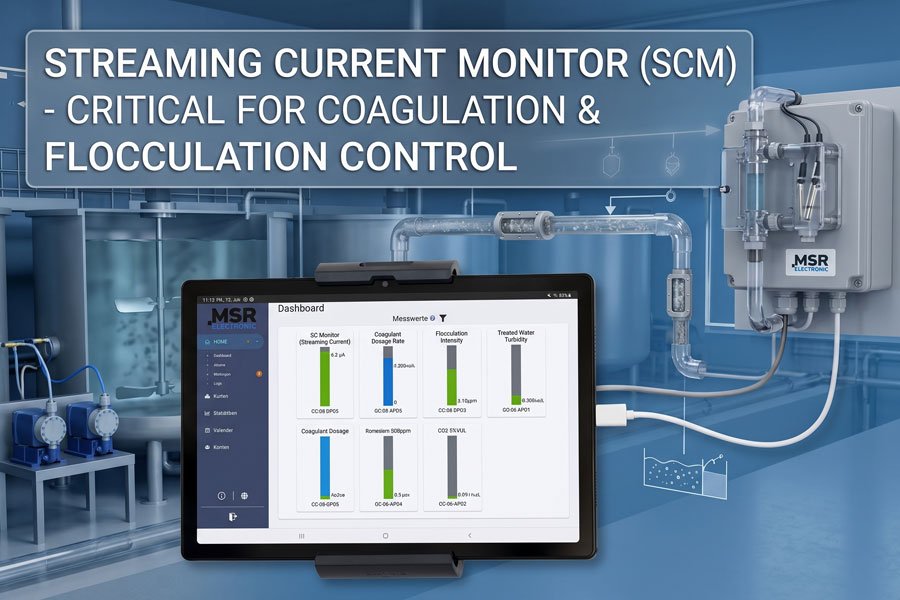
In the field of water treatment and industrial process control, the precise management of chemical dosing is paramount. The streaming current monitor (SCM) serves as a critical instrument for real-time monitoring and control of coagulation and flocculation processes. By measuring the net electrical charge of particles in a liquid suspension, the SCM allows operators to optimize chemical dosing, thereby ensuring water quality while minimizing chemical waste.
The fundamental principle underlying the streaming current monitor is the measurement of the streaming current, which is generated by the movement of charged particles relative to a stationary surface. In a typical aqueous suspension, particles possess a surface charge, often characterized by the zeta potential. When these particles are forced to move through a narrow channel or past a sensor, the counter-ions in the diffuse layer are displaced, creating a measurable electrical current. This current is directly proportional to the net charge of the particles in the sample stream.
By maintaining a constant flow or pressure, the device provides a continuous output that reflects the instantaneous charge demand of the water, which is essential for determining the optimal dosage of coagulants such as alum or ferric chloride.
Operational Mechanisms in Water Treatment
The primary application of the streaming current monitor is the automation of coagulant dosing in water treatment plants. Traditionally, jar testing was the standard method for determining chemical requirements; however, this approach is discrete and cannot account for rapid changes in raw water quality. The SCM provides a continuous, real-time signal that allows for closed-loop control systems to adjust dosing pumps automatically.
When a coagulant is added to raw water, it neutralizes the negative surface charge of colloidal particles, allowing them to aggregate into larger flocs. The SCM detects the “zero charge” point, which typically corresponds to the point of optimal coagulation. If the SCM reading deviates from the established setpoint, the control system increases or decreases the coagulant feed rate accordingly. This ensures that the process remains within the optimal range, preventing both under-dosing (which leads to poor water quality) and over-dosing (which increases operational costs and sludge production).
Design and Maintenance Considerations
A streaming current monitor consists of a sensor probe, a reciprocating element, and an electronic signal processor. The sensor must be kept clean to ensure accurate readings, as fouling or scaling can interfere with the charge measurement. Modern SCM units are designed with self-cleaning mechanisms, to maintain sensor sensitivity in challenging industrial environments.
Calibration is another vital aspect of SCM maintenance. Because the streaming current signal is sensitive to changes, the monitor must be calibrated against the specific water matrix it is monitoring. In complex industrial processes, such as paper manufacturing or wastewater treatment, the presence of surfactants or polymers can also influence the streaming current, necessitating careful interpretation of the data.
Advanced Applications and Future Trends
The integration of SCM data into digital twin models and AI-driven process control systems represents the next frontier in water management. By combining real-time charge data with other parameters like turbidity, pH, and flow rate, operators can achieve unprecedented levels of process stability. As industrial standards for water discharge become more stringent, the role of the streaming current monitor as a reliable, high-precision analytical tool will only continue to grow in importance.


 English
  Indonesian