
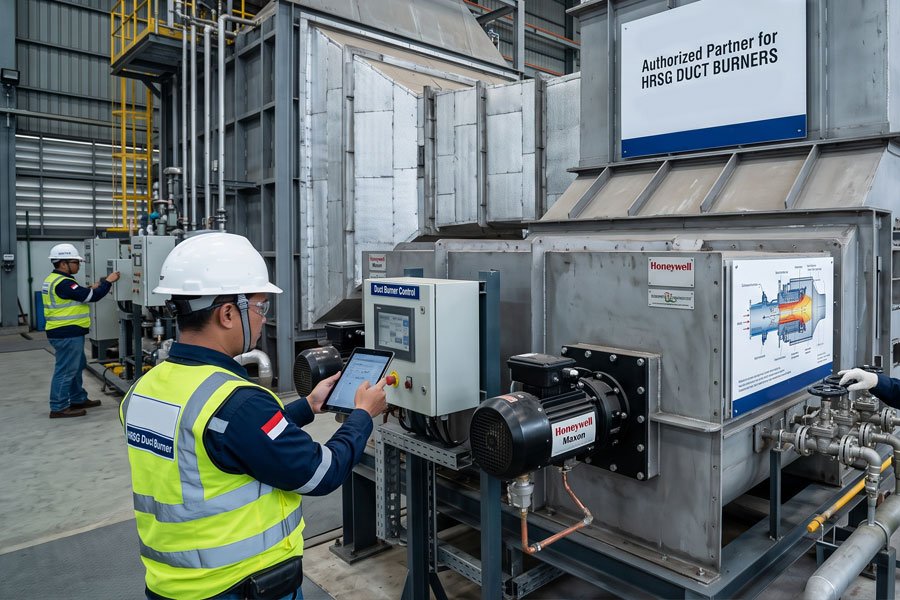
The Heat Recovery Steam Generator (HRSG) serves as the critical thermal bridge between the gas turbine and the steam cycle in combined-cycle power plants. To maximize the operational flexibility and steam production capacity of these systems, engineers frequently integrate a duct burner system. An HRSG duct burner is a specialized combustion device installed within the exhaust gas stream of a gas turbine, designed to supplement the heat content of the exhaust gases before they reach the heat transfer surfaces of the HRSG. By injecting and burning fuel directly into the oxygen-rich turbine exhaust, the system allows for independent control of steam production, ensuring that power plants can meet fluctuating steam demands without necessarily increasing the load on the gas turbine itself.
The fundamental thermodynamic principle governing the performance of an HRSG duct burner relies on the utilization of the excess oxygen remaining in the gas turbine exhaust. Modern gas turbines operate with high excess air ratios to maintain turbine inlet temperatures within metallurgical limits. Consequently, the exhaust gas typically contains 12% to 15% oxygen by volume, providing a ready-made oxidant for the duct burner.
The integration of these burners allows for a significant increase in steam mass flow and temperature, effectively decoupling the gas turbine power output from the steam cycle power output.
Design Considerations and Operational Dynamics
The design of an HRSG duct burner is a complex engineering challenge that must account for extreme thermal gradients and flow uniformity.
Furthermore, the burner must be capable of stable operation across a wide range of turbine loads. During “duct firing” mode, the fuel-air ratio must be carefully managed to ensure complete combustion to comply with increasingly stringent environmental regulations. The control system for the duct burner is usually integrated into the plant’s Distributed Control System (DCS), allowing for automated modulation of fuel flow based on real-time steam demand signals.
Benefits of Duct Firing in Combined Cycle Plants
The primary advantage of employing an HRSG duct burner is the operational flexibility it affords the plant operator. In many industrial applications, such as cogeneration or combined heat and power (CHP) plants, the demand for process steam does not always correlate with the demand for electricity. By utilizing duct firing, the plant can increase steam production during periods of high thermal demand without needing to ramp up the gas turbine, which might be constrained by grid requirements or fuel costs.
Additionally, duct burners provide a mechanism for “peaking” capacity. During periods of high electricity prices, the burner can be fired to increase the steam turbine output, thereby boosting the total power generation of the combined-cycle block. This capability makes the HRSG duct burner an essential component for plants operating in competitive energy markets where the ability to respond rapidly to price signals is a significant economic advantage.
Maintenance and Reliability
Reliability is paramount for any combustion system within a power plant. The harsh environment of the exhaust duct—characterized by high temperatures and potential vibration—requires the use of high-grade alloys for the burner grid. Regular inspections are necessary to check for erosion, corrosion, or mechanical deformation of the burner elements. Furthermore, the flame scanners and igniters must be maintained in peak condition to ensure safe startup and continuous monitoring of the combustion process. Failure to maintain these components can lead to flame instability, which not only reduces efficiency but also poses a safety risk to the entire HRSG structure.
In summary, the HRSG duct burner is a sophisticated piece of equipment that transforms a standard combined-cycle plant into a highly flexible energy production facility. By leveraging the excess oxygen in turbine exhaust, it provides a reliable and efficient method for augmenting steam production. As the energy industry continues to move toward more integrated and responsive power systems, the role of advanced combustion technologies like the duct burner will remain central to achieving optimal thermal efficiency and operational versatility.

 English
  Indonesian